
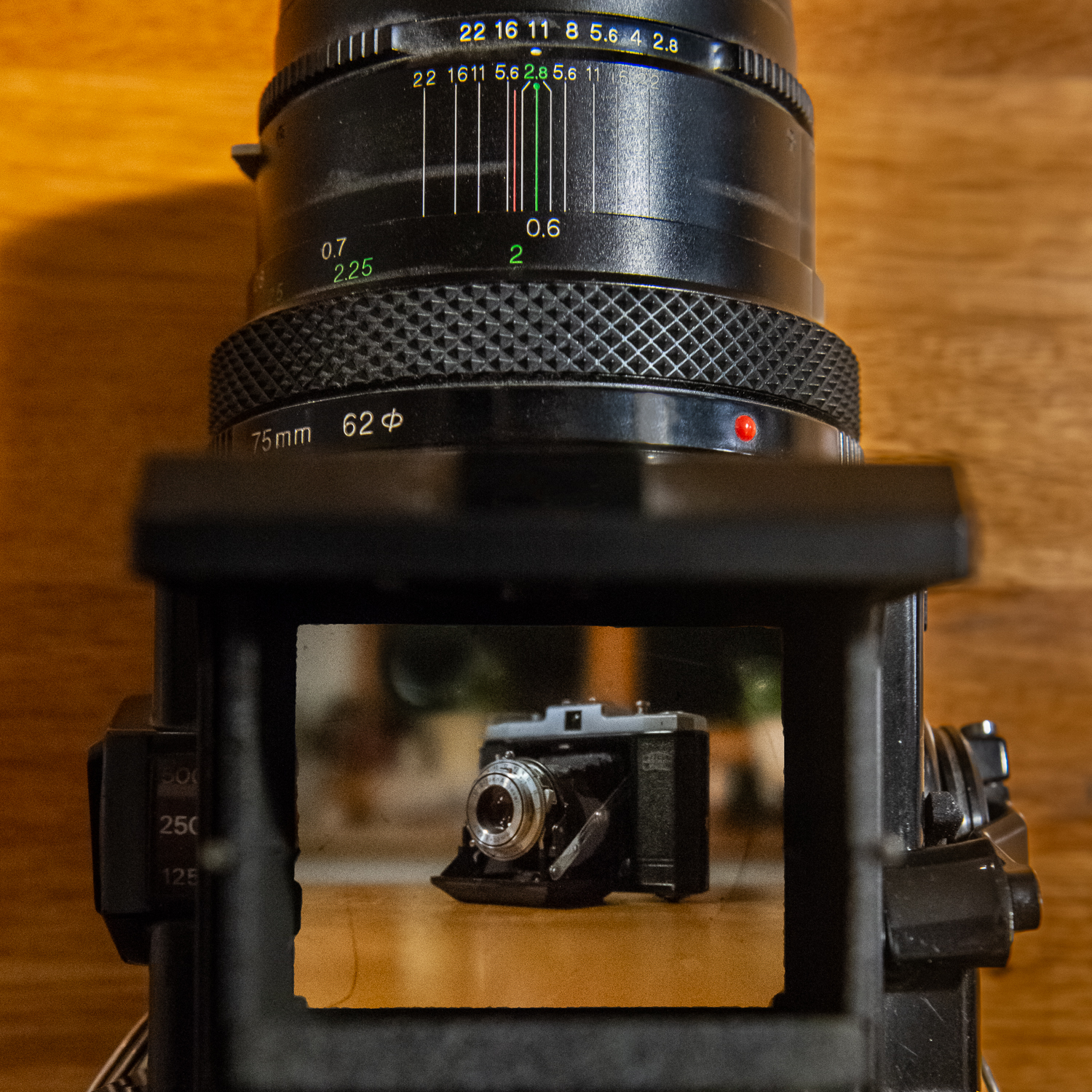
Today’s Flickr 21 Challenge is “camera”, so here are 2 of my older film cameras. The viewfinder you are looking through belongs to my Zenza Bronica ETR-Si and the camera being photographed is my Zeiss Icon Nettar folding camera. You can see more photographs of the Zenza Bronica ETR-Si here and photographs of the Zeiss Icon Nettar can be found here.
Here’s a brief history of both cameras from ChatGPT:
The Zenza Bronica ETRSi is a 6×4.5cm medium format SLR camera that was introduced in 1989 by Zenza Bronica (later acquired by Tamron). It was the final and most refined model in the ETR series, which began with the ETR (1976) and continued with the ETR-C (1977) and ETR-S (1979).
Designed as a modular system, the ETRSi featured interchangeable lenses, film backs, viewfinders, and grips, making it a versatile choice for professional and advanced amateur photographers. The camera was known for its leaf shutter lenses, allowing flash sync at all speeds up to 1/500s. It introduced mirror lock-up, improved ergonomics, and better handling over its predecessors.
The ETRSi remained in production until 2004, when Bronica ceased camera manufacturing. Today, it is still appreciated for its affordable entry into medium format photography, reliable build, and excellent Zenzanon lenses.
The Zeiss Ikon Nettar was a series of medium format folding cameras produced by Zeiss Ikon between the 1930s and 1950s. Designed as a more affordable alternative to the higher-end Zeiss Ikon Ikonta, the Nettar was aimed at amateur photographers seeking a reliable yet budget-friendly camera.
The Nettar cameras used 120 roll film, producing 6x6cm or 6x9cm negatives, depending on the model. They featured a simple yet durable folding bellows design, a variety of fixed lenses (typically Nettar Anastigmat or Novar-Anastigmat), and leaf shutters from manufacturers like Prontor or Compur. While they lacked rangefinders, they used zone focusing, making them easy to operate.
The Nettar series remained popular due to its solid construction, portability, and affordability. Though production ceased in the late 1950s, these cameras are still sought after by collectors and film photography enthusiasts for their classic design and image quality.
