
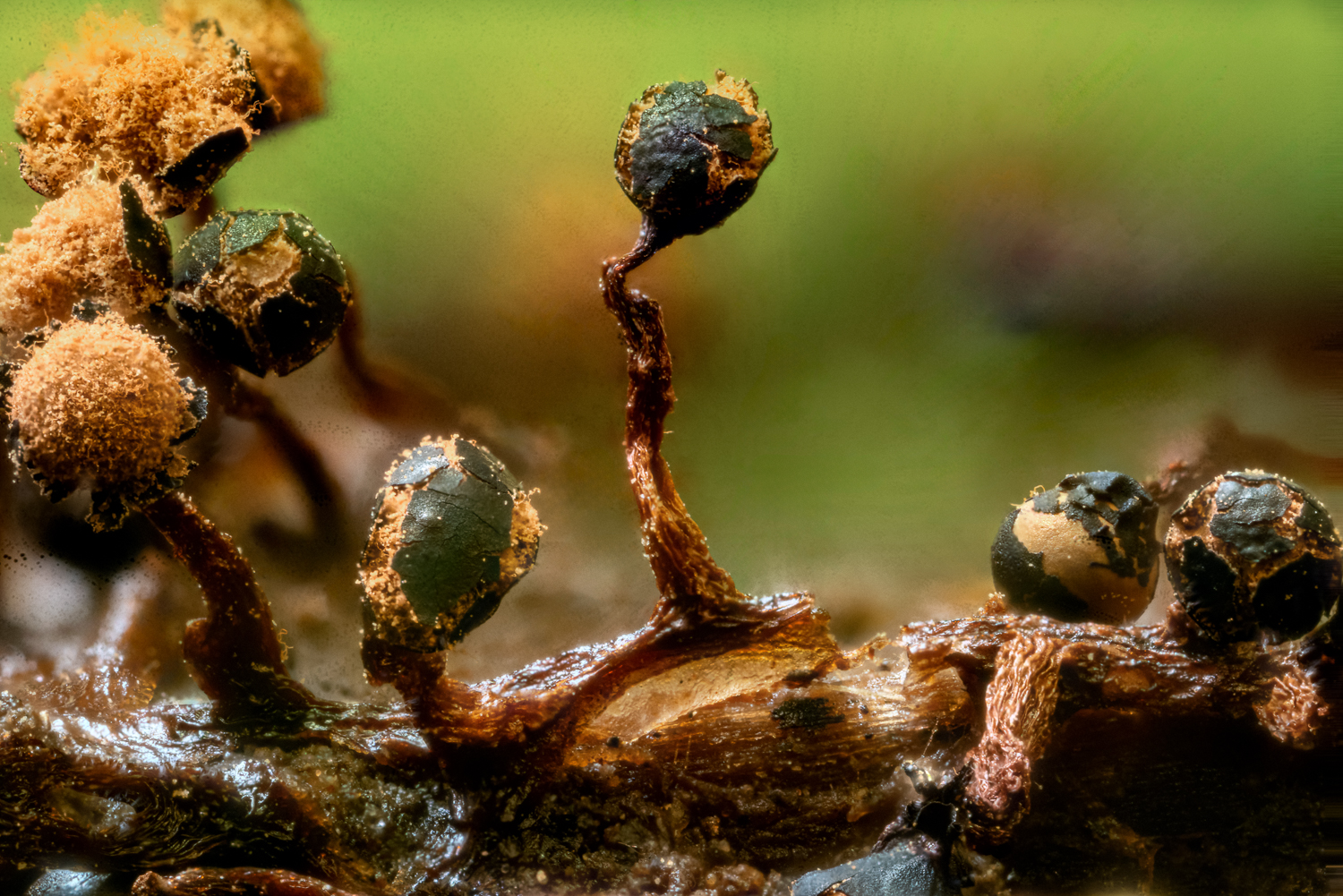
A few years ago I saw a talk at Bishop’s Stortford Camera Club about macro photography by Andy Sands and this included a lot of extreme macro images. I was fascinated with the types of things you could see, or should I say, couldn’t see and really fancied having a go at this type of photography. Nothing, of course, happened! I then stumbled on Alan Walls You Tube channel a few weeks ago and it all came back to me. So, having watched a few videos I had a go.
It’s not easy!
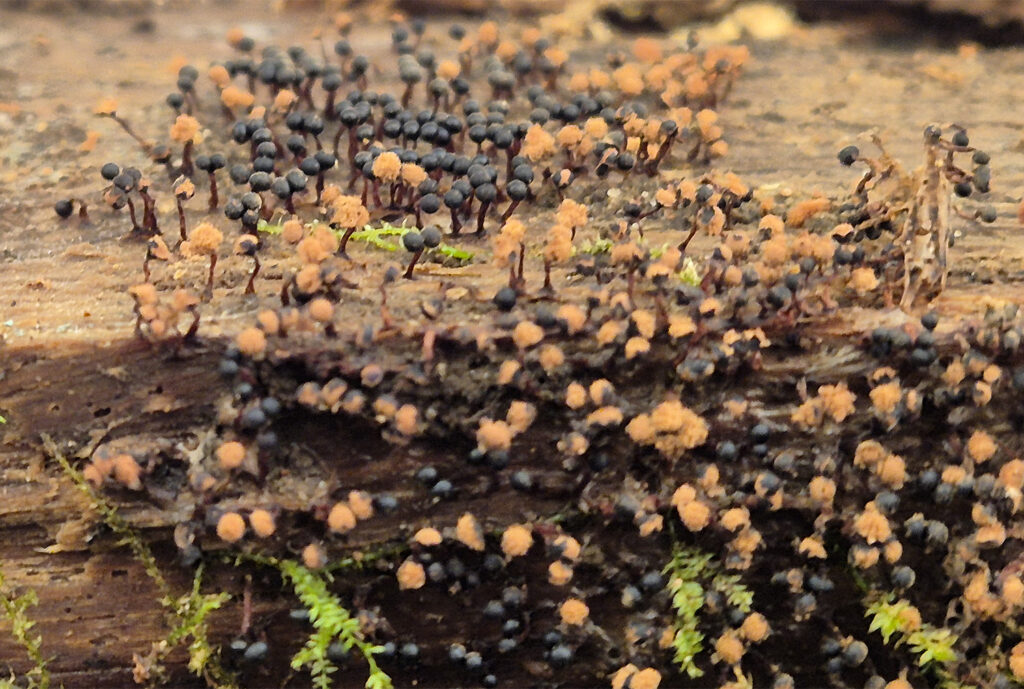
First you have to find them. I was doing some gardening and found some partially buried old wood planks. I pulled up a few and on the last one I spotted something orange looking which, on closer inspection, was some slime mold. I immediately abandoned the gardening and took the wood into the garage for photography. Here’s a mobile close up shot of them in situ – they are each about 2 or 3mm high and a little less than 1mm wide.
As they are so tiny you have to use a macro lens to photograph them and the depth of field (the amount that’s actually in focus) is tiny. The main image is with a 3.5x magnification – the depth of field available is miniscule (less than 0.1mm) so to get something with sufficient depth of field means taking multiple photographs each focused on a slightly different part of the photo – called focus stacking. The main photo above took 25 photos all combined in software called Zerene Stacker.
Getting a composition that works is also pretty tricky. I’ve learnt that less is definitely more with these.
Here’s my second favourite shot of the six I took:
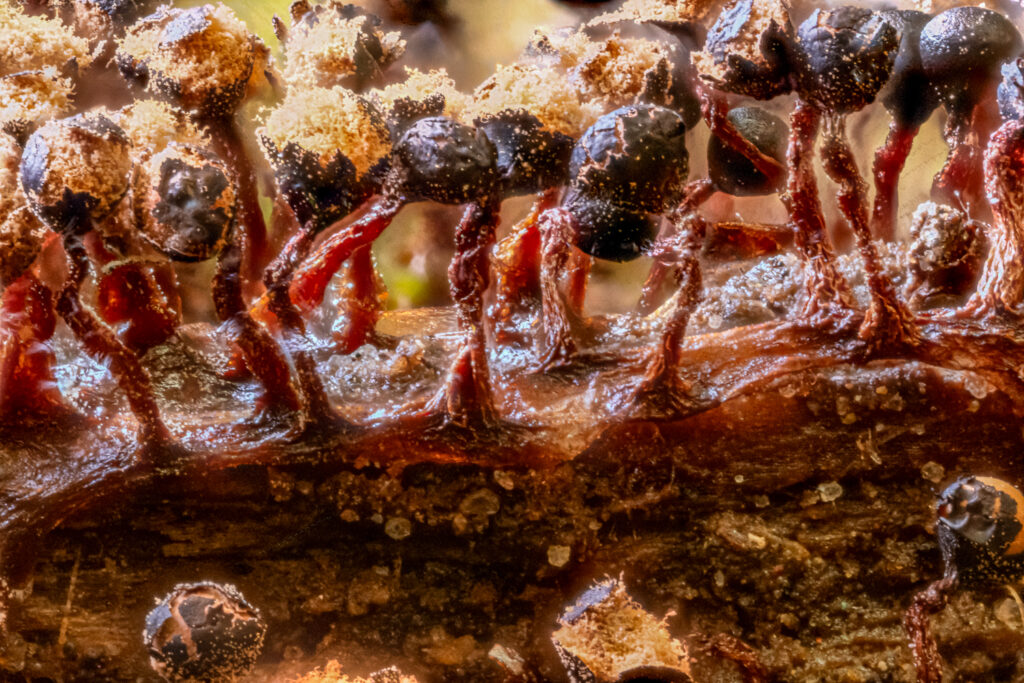
The blackish spheres (Sporocarps) are the spore-producing bodies of this slime mould species. The shiny outer layer (the peridium) splits open releasing a fluffy yellow mass of threads called elaters.
