
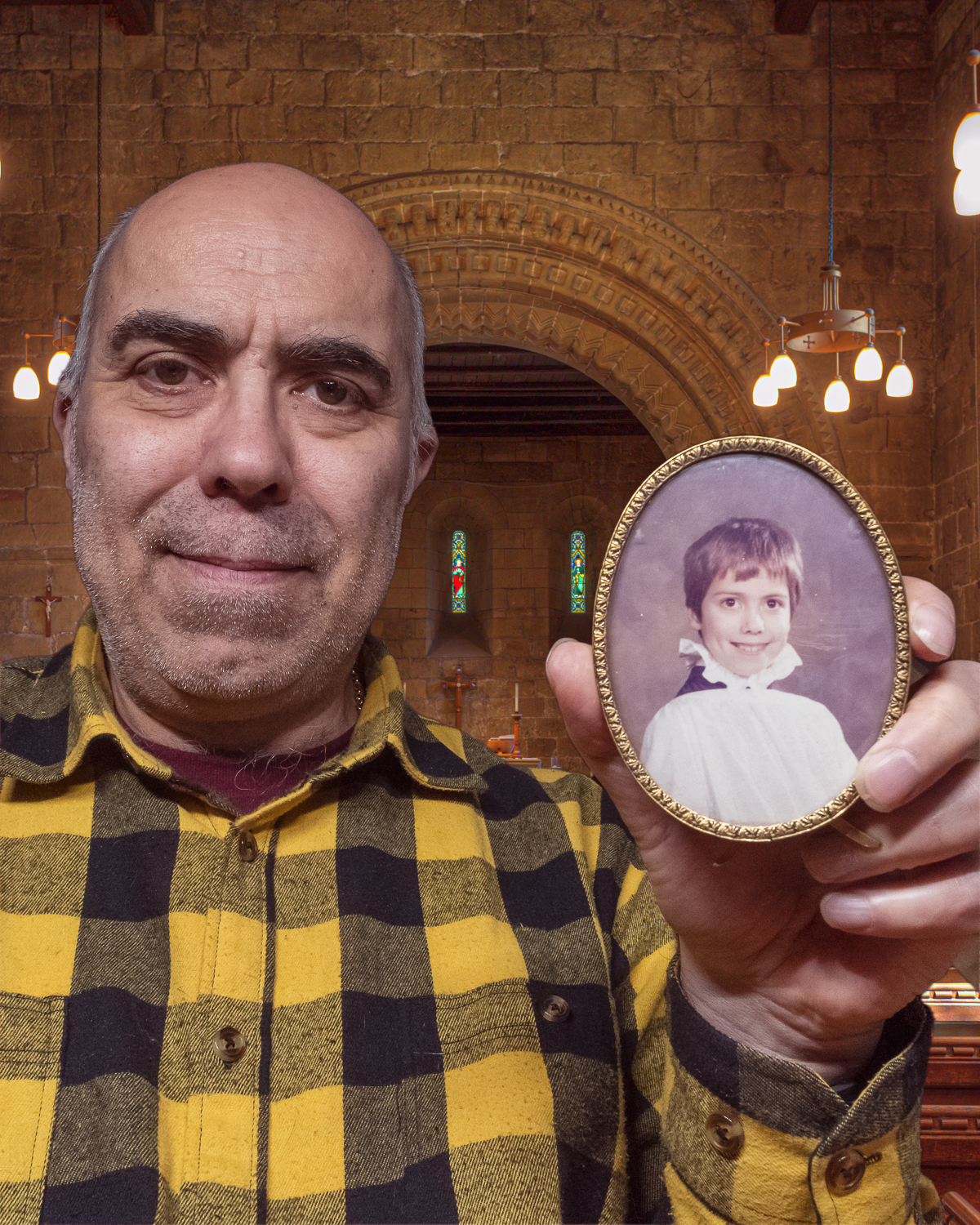
Today’s Flickr 21st Challenge is “Memories” so I thought a couple of “selfies” would do. As you can probably see I was, many years ago, a choir boy for a few years at Adel Parish Church. This was shortly before becoming one of those punk rocker nuisances, frightening old ladies left, right and centre (not!).
I’m still a punk rocker. well, I still listen to punk rock music, I don’t feel the need to dress up anymore and I no longer have the hair for any wild Mohican haircuts 😉
So, the main shot was taken today of me holding the early picture of me as a choir boy. The church interior in the background is, indeed, Adel Parish Church but taken just 4 years ago (it hasn’t really changed except they no longer have the old organ) – you can see details here – Adel Parish Church
Let’s see what our old pals at ChatGPT can tell us about the church:
The History of Adel Parish Church: A Hidden Gem in Yorkshire
Nestled in the leafy suburb of Adel, Leeds, Adel Parish Church—officially known as St. John the Baptist Church—stands as one of the finest and most well-preserved Norman churches in England. This historic church, with its rich architectural details and centuries of heritage, has remained a beacon of faith and history for nearly a millennium.
Early History and Norman Origins
The origins of Adel Parish Church date back to the 12th century, during the reign of King Henry I (1100–1135). Built around 1150, the church is a stunning example of Norman architecture, a style brought to England by the Normans after their conquest in 1066. Adel was an important settlement at the time, and the construction of the church reflected the growth of Christianity and feudal governance in medieval Yorkshire.
Architectural Significance
Adel Parish Church is renowned for its exquisite and well-preserved Norman features. The west doorway is particularly noteworthy, adorned with intricate carvings depicting biblical and mythical creatures, a hallmark of Romanesque art. Inside, the church retains its original rounded arches and thick stone walls, which showcase the engineering prowess of Norman builders.
The chancel arch is another striking feature, with its detailed carvings and elaborate capitals, reflecting a mixture of religious and mythical symbolism. The south door tympanum is especially famous, displaying an elaborate depiction of Christ with a host of symbolic figures.
Medieval and Later Additions
Despite its predominantly Norman design, Adel Parish Church has seen various modifications over the centuries. In the 14th and 15th centuries, Gothic influences began to appear, particularly in the addition of new windows and other decorative elements. However, the church has largely retained its original Romanesque character, a rarity among medieval English churches.
Role in the Community
Throughout its long history, St. John the Baptist Church has been a cornerstone of the Adel community. From medieval times through the Reformation and into the modern era, the church has continued to serve as a place of worship and local gathering. It remains an active Anglican parish today, with regular services and events that bring together both history enthusiasts and worshippers alike.
Preservation and Legacy
Due to its historical and architectural significance, Adel Parish Church is a Grade I listed building, ensuring its protection for future generations. The church has been carefully maintained to preserve its medieval charm while adapting to the needs of contemporary worshippers. Visitors from across the UK and beyond continue to be drawn to its stunning craftsmanship and tranquil setting.
Visiting Adel Parish Church
For those with an interest in history, architecture, or simply seeking a peaceful retreat, a visit to Adel Parish Church is a must. The church is open to visitors throughout the year, offering a unique glimpse into England’s Norman past and the enduring legacy of faith in Yorkshire.
Adel Parish Church stands as a testament to the artistry and devotion of its builders, a hidden gem in Yorkshire that continues to inspire all who walk through its ancient doors.
